
Introducción a la ciencias de la computación en JavaScript (Corgi)
- Level High School
- Contact Hours 125
- Timeframe Year
Este curso enseña los fundamentos de la informática y la programación básica, haciendo hincapié en ayudar a los alumnos a desarrollar el pensamiento lógico y la capacidad para resolver problemas. Los alumnos aprenden material equivalente a un curso universitario semestral de introducción a la informática y pueden programar en JavaScript al finalizarlo.
To view the entire syllabus, click here or click to explore the full course.
MODULES - 14
Los alumnos aprenden los fundamentos de la programación dando a Karel las órdenes del Perro en un mundo cuadriculado.
Los alumnos aplican todos los conceptos fundamentales de Introducción a Karel para resolver nuevos retos.
Los estudiantes aprenden los fundamentos de JavaScript, incluyendo variables, entradas del usuario, matemáticas y funciones.
Los alumnos aprenden a añadir objetos gráficos y a colocarlos en el lienzo.
Los alumnos aplican lo que han aprendido sobre gráficos y JavaScript básico para completar una serie de retos.
Los alumnos aprenden a utilizar estructuras de control como las declaraciones if/else y los bucles para crear programas avanzados en JavaScript.
Los alumnos aplican los conceptos fundamentales del módulo Estructuras de Control para resolver nuevos retos.
Los alumnos aprenden a escribir código reutilizable con funciones, parámetros y valores de retorno, y exploran el impacto de los ámbitos de las variables.
Los alumnos utilizan lo que han aprendido en el módulo Funciones para resolver nuevos retos.
Los alumnos aprenden a hacer que los objetos se muevan por la pantalla y a que los usuarios interactúen utilizando el ratón.
Los alumnos aplican todos los conceptos fundamentales del módulo Animaciones para resolver nuevos retos.
Los alumnos aprenden a crear su propio juego Breakout desde cero utilizando JavaScript.
¡Los alumnos aplican las habilidades que han aprendido a lo largo del curso para crear un programa original!
Este curso finaliza con un examen tipo test de 25 preguntas.
Explore programs that your students will build throughout this course!
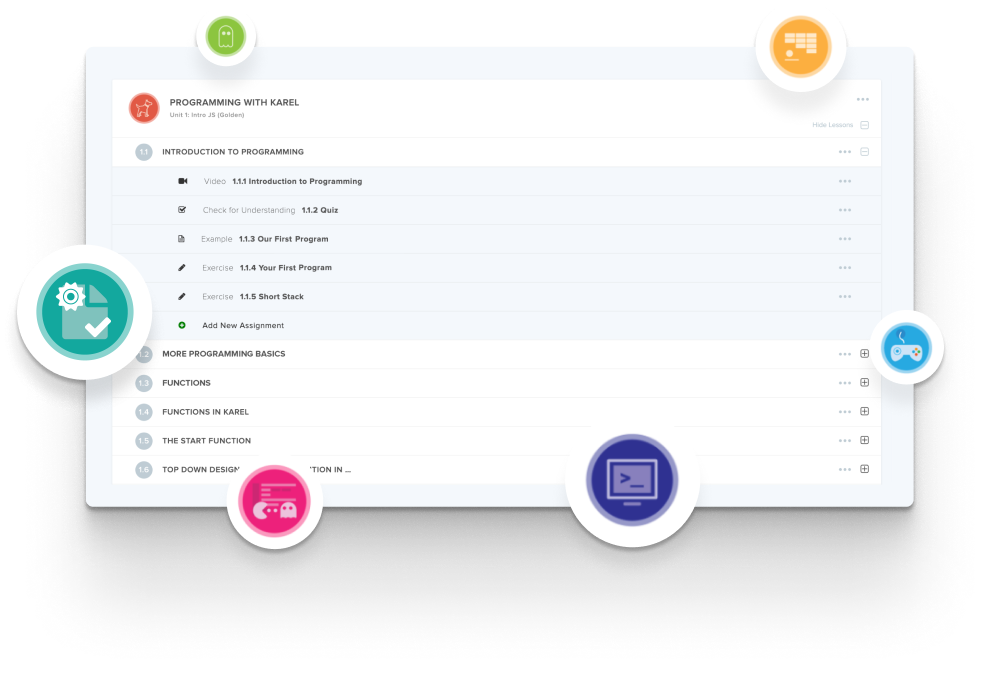
Here are a few examples of teacher resources and materials to use in the Introducción a la ciencias de la computación en JavaScript (Corgi) course
The CodeHS JavaScript Level 1 Certification offers high school students the opportunity to validate their mastery of JavaScript, giving them a competitive advantage when entering college or the workforce.
Learn MoreDive into the basics of programming and learn how to lead a successful introductory computer science class. This course covers everything from learning effective debugging methods to teaching computer science in a blended classroom. Perfect for teachers with limited or no programming experience.
View Units CodeHS PD Options| Standards Framework | Alignment |
|---|---|
| Nebraska Foundations of Computing | 58% View |
| JSE Certified Entry-Level JavaScript Programmer (JSE-40-01) | 57% View |
Create and organize Assignments in any CodeHS course that you're teaching. You can even add custom assignments to pre-existing CodeHS courses.
Learn MoreDidn't find what you were looking for? Here are a few links that might be useful to you.
Yes. Introduction to Computer Science in JavaScript (Corgi) is the CodeHS flagship intro course, built to start from zero. Students begin by giving simple commands to Karel the Dog, then move into writing real JavaScript. It covers material equivalent to a one-semester college introductory CS course, making it a solid foundation for any student new to programming.
No. Introduction to Computer Science in JavaScript (Corgi) assumes no prior coding experience. It opens with Karel the Dog, where students learn programming logic like loops, conditionals, and functions by moving a dog through a grid before any JavaScript syntax. The course introduces each concept step by step, so students who have never written code can start here comfortably.
Students build a range of programs in Introduction to Computer Science in JavaScript (Corgi). They start by solving Karel the Dog puzzles, then create graphics and animations on a canvas, program mouse and keyboard interactions, and build a fully working Breakout arcade game from scratch. The course ends with an original final project students design and code themselves.
Introduction to Computer Science in JavaScript (Corgi) uses JavaScript because it runs in any web browser with nothing to install, and it makes visual, interactive results easy to see right away. Students can draw graphics, animate them, and build games in the browser, which keeps a first CS course engaging while teaching the core concepts found in any programming language.
Both are beginner CS courses from CodeHS that need no prior experience; the main difference is language and style. Introduction to Computer Science in JavaScript (Corgi) starts with Karel the Dog and leans into browser graphics, animation, and games, while Introduction to Python Programming teaches the same fundamentals in Python, known for readable, text-based syntax. Choose the one that fits your pathway.
No. Teachers do not need a computer science background to teach Introduction to Computer Science in JavaScript (Corgi). CodeHS provides lesson plans, answer keys, example solutions, and a teacher dashboard, plus optional professional development designed for teachers with limited or no programming experience. Many teachers learn alongside their students using the built-in resources.
Yes. Introduction to Computer Science in JavaScript (Corgi) prepares students for the CodeHS JavaScript Level 1 Certification and includes a built-in practice module with review quizzes so students can build toward the certification as they learn the fundamentals of programming in JavaScript.
After Introduction to Computer Science in JavaScript (Corgi), CodeHS recommends the AP Computer Science pathway: AP Computer Science Principles, then AP Computer Science A. It also feeds a web development pathway into Web Development and Mobile Apps. Students can even take Introduction to Python Programming next; many concepts carry over, but its different approach makes it a great way to learn a second language and see how the same ideas apply.