




Digital Literacy and Artificial Intelligence
- Level High School
- Contact Hours 115
- Timeframe Year
In this course, students will learn the importance of safeguarding our increasingly digital world from unauthorized access. They will be introduced to the fundamentals of computer programming and how to design, code, and test programs. Students also examine key ideas in artificial intelligence, such as machine learning, large language models, bias in AI systems, and the impact of AI on society, while working with tools like ChatGPT, Gemini, and Teachable Machine to understand how AI systems are built and used.
Activities in this course require student access to third party AI tools including ChatGPT; Gemini; Microsoft Copilot; Google Teachable Machine; Google AI Experiments (Quick, Draw!, etc.); Stable Diffusion (Hugging Face).
Please review the tools listed in the course syllabus.
To view the entire syllabus, click here or click to explore the full course.
MODULES - 14
Students explore key areas such as personal data collection, the reliability of online information, cyber ethics and laws, personal data security, cybersecurity essentials, and strategies to combat common cyber threats and their prevention, equipping individuals with the knowledge to navigate the digital landscape responsibly and securely.
Students examine how the internet and digital technologies impact various aspects of modern life, from personal behavior to global communication. Through readings, reflections, and interactive routines, learners explore both the benefits and challenges of a digitally connected world.
Students learn the basics of programming by writing programs that interact with users through the keyboard.
Students teach their programs to make decisions based on the information it receives.
Students write a program that quizzes users on a series of multiple-choice questions and checks their answers.
Students learn how to write more efficient code by using loops as shortcuts.
Students write a program to provide feedback on whether the entered password is correct or incorrect.
Students will be introduced to the concept of code reuse and modification by remixing a program created by another student. They will learn about attribution and the importance of giving credit to the original creators of code.
In this module, students will gain an understanding of the main concepts and vocabulary around AI.
Students will learn the fundamentals of machine learning, covering its lifecycle, supervised, unsupervised, and reinforcement learning, and explore bias within learning models.
In this hands-on module, students will learn how to train AI models and will explore the use cases for AI in various industries.
Students will explore the ethical implications and risks of AI technology, including bias, hallucinations, security, misinformation, and legal challenges. Students will engage in a debate about AI and create their own AI policies.
Students will create a game, then solve a real-world problem with the help of AI.
Students will explore the changing landscape of work in the age of AI.
Explore programs that your students will build throughout this course!
Here are a few examples of teacher resources and materials to use in the Digital Literacy and Artificial Intelligence course
| Standards Framework | Alignment |
|---|---|
| Maryland Machine Learning and Data Science I | 58% View |
| Maryland Machine Learning and Data Science II | 48% View |
| Arizona 9-12 | 41% View |
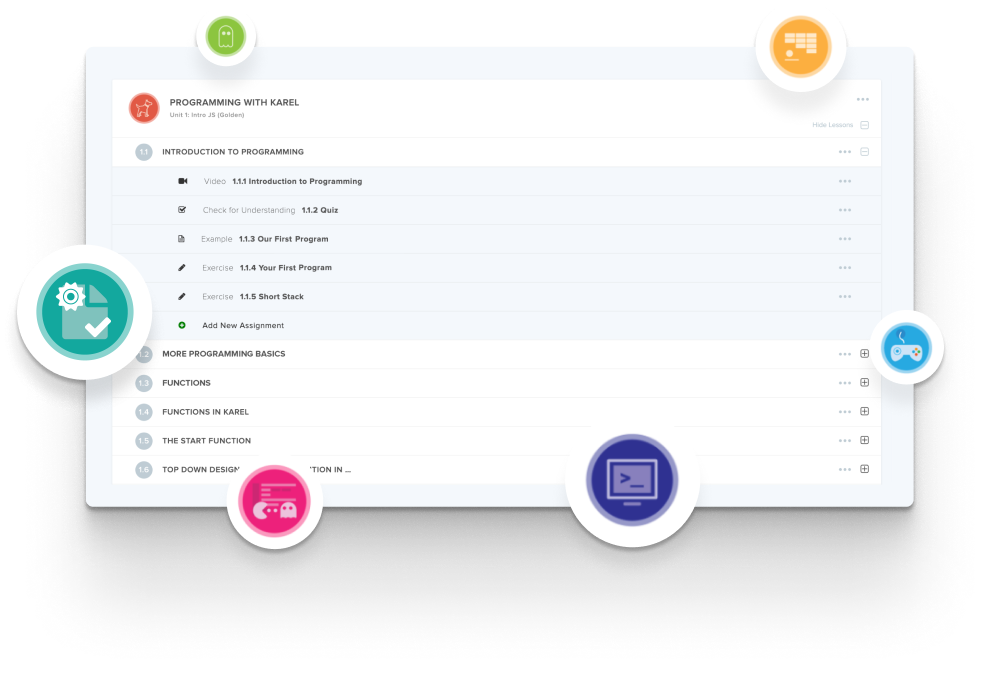
Create and organize Assignments in any CodeHS course that you're teaching. You can even add custom assignments to pre-existing CodeHS courses.
Learn MoreDidn't find what you were looking for? Here are a few links that might be useful to you.
A one-year course where students learn about online safety, programming fundamentals, and examine AI ideas including machine learning, large language models, bias, and societal impact. The courses uses AI tools including ChatGPT, Gemini, and Teachable Machine.
Gemini can substitute for ChatGPT and Hugging Face in many lessons. There is a supplemental module full of alternative assignments that feature a variety of low-tech, accessible, or different ways for students to engage with course material. Lakera requires an account, but the other tools are able to be used logged out.