South Carolina Fundamentals of Computing
- Level High School
- Contact Hours 165
- Timeframe Year
This course introduces students to the field of computer science through exploration of a wide range of computing topics. Using critical thinking and creativity, students will design and build computational artifacts through both individual and team projects. Along the way, they'll develop foundational knowledge in computer operation, programming, web design, data, physical computing, machine learning, and the societal and ethical dimensions of computing. The course also connects students to computing careers and the role computing plays across all other career fields.
Activities in this course require student access to third party AI tools including ChatGPT; Gemini; Microsoft Copilot; Google Teachable Machine; Sketch-RNN (Google Magenta); Google AI Experiments (Quick, Draw!, etc.).
Please review the tools listed in the course syllabus.
To view the entire syllabus, click here or click to explore the full course.
MODULES - 17
Students explore multiple topics including Internet etiquette and how to stay safe on the world wide web. They will also look at the potential effects of their digital footprints, how to protect information from online risks, and the implications of cyberbullying.
Students explore the core principles of cybersecurity, including the CIA Triad, symmetric and asymmetric cryptography, and authentication methods. They examine the ethics of hacking and consider career pathways in cybersecurity.
Students learn to read and create data visualizations, examine how data is collected and its limitations, and apply these skills by building an original data dashboard from real data.
Students review a history of computing, learn about the various parts that make up modern computers, learn about the impact computing has had on today's world, and learn about the impacts computing could potentially have in the future.
Students learn the basics of programming by giving Karel the Dog commands in a grid world.
Students apply all the foundational concepts from Intro to Karel to solve new challenges.
Students learn the basics of JavaScript including variables, user input, mathematics, and functions.
Students learn how to add graphics objects and position them on the canvas.
Students apply what they have learned about graphics and basic JavaScript to complete a set of challenges.
Students explore the structure and design of the internet, and how this design affects the reliability of network communication, the security of data, and personal privacy.
In this project, you will explore cybersecurity career pathways and build skills that will be needed within these fields such as communication.
Students are introduced to a high-level introduction of HTML and CSS and create several simple web pages using the CodeHS IDE.
In this module, students will gain an understanding of the main concepts and vocabulary around AI.
Students will learn the fundamentals of machine learning, covering its lifecycle, supervised, unsupervised, and reinforcement learning, and explore bias within learning models.
Students learn what makes an engaging and accessible user interface, and employ an iterative design process including rapid prototyping and user testing to design and develop their own engaging web pages.
In this module, students explore computing careers and the professional skills needed to enter the field. They investigate the five computing disciplines, research job paths and certifications, and examine student organizations like FBLA, TSA, and SkillsUSA. Students also build resumes, practice interview techniques, and study workplace safety practices including electrical hazards, ergonomics, and fire suppression.
Explore programs that your students will build throughout this course!
Here are a few examples of teacher resources and materials to use in the South Carolina Fundamentals of Computing course
| Standards Framework | Alignment |
|---|---|
| South Carolina Fundamentals of Computing | 100% View |
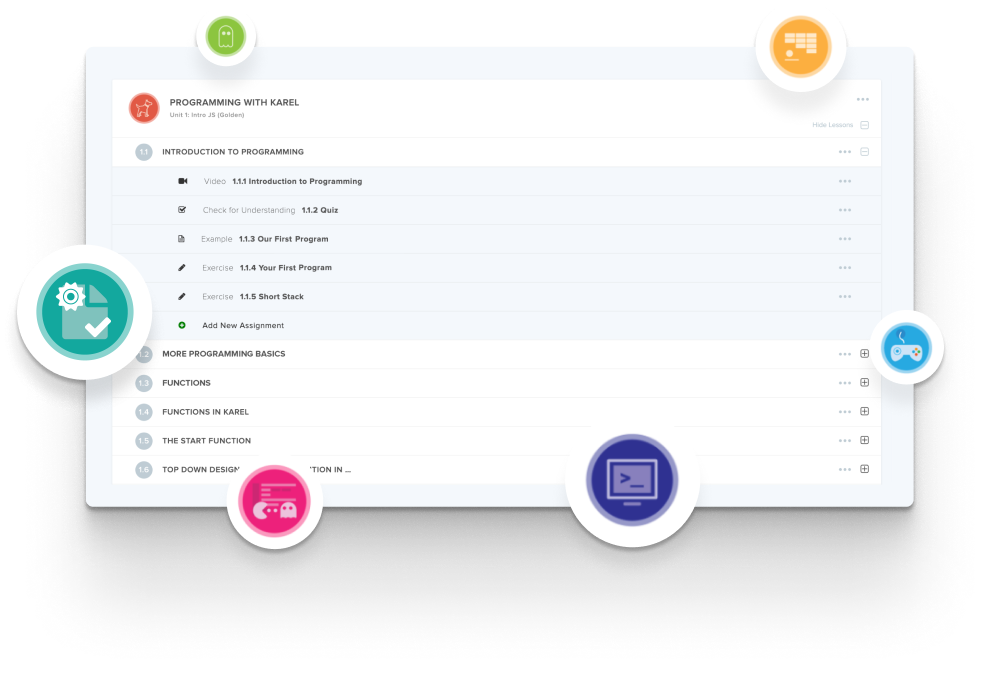
Create and organize Assignments in any CodeHS course that you're teaching. You can even add custom assignments to pre-existing CodeHS courses.
Learn MoreDidn't find what you were looking for? Here are a few links that might be useful to you.
It aligns to 100% of the South Carolina Fundamentals of Computing standards. The standards page shows each standard alongside the lesson that covers it.
It introduces computer science through a wide range of topics: computer operation, programming, web design, data, physical computing, machine learning, and the societal and ethical dimensions of computing. Students design and build projects individually and in teams.
No. The course is an introduction to the field and assumes no background. It is built around critical thinking and creativity rather than prior coding skill.
The course is built for about 165 contact hours across a full school year.
Yes. It connects students to computing careers and shows the role computing plays across other career fields, which is part of why it works as a first CTE course in a pathway.