





Georgia Introduction to Software Technology
- Level High School
- Contact Hours 160
- Timeframe Year
This course is the foundational course for many Georgia IT pathways. It is designed for high school students to understand, communicate, and adapt to a digital world as it impacts their personal life, society, and the business world.
To view the entire syllabus, click here or click to explore the full course.
MODULES - 13
Students learn topics on Internet etiquette and how to stay safe on the world wide web. Students will look at the potential effects of their digital footprints, how to protect information from online risks, and the importance of creative credit.
Students learn the basics of programming by giving Karel the Dog commands in a grid world.
Students apply all the foundational concepts from Intro to Karel to solve new challenges.
Students will learn about the physical elements of computers and networking such as motherboards, RAM, routers, and the use of port numbers, ethernet, and wireless devices.
Students will compare and contrast common operating systems (Windows, Linux, OS) and explain the importance of compatibility. Students will also explore software and apps while discussing software licenses and running through the software development life cycle.
In this project, students explore career pathways and build skills that will be needed within these fields such as communication.
Students learn about the language behind all websites: HTML. Students learn about several different HTML tags as well as the basic structure of a web page. Students use HTML to develop several of their own creative web pages.
Students learn the language CSS and use it to style their web pages. Students learn about the benefits of styling with CSS and will use CSS to create several styled web pages of their own.
Students build their own websites about themselves. This site will be accessible on their own custom domain and will be continually improved by the student as they continue on in the course. It will serve as a running portfolio of each creative project they create in the course.
Students learn the basics of JavaScript including variables, user input, mathematics, functions, and graphics.
Students will learn and apply the basic elements of web development, such as using JavaScript and the DOM, collecting and storing data, and using file structure.
Students take some time to explore and discover different computer science careers. They will also examine inclusive coding and how to avoid bias in computer programming.
Explore programs that your students will build throughout this course!
Here are a few examples of teacher resources and materials to use in the Georgia Introduction to Software Technology course
| Standards Framework | Alignment |
|---|---|
| Georgia Introduction to Software Technology | 100% View |
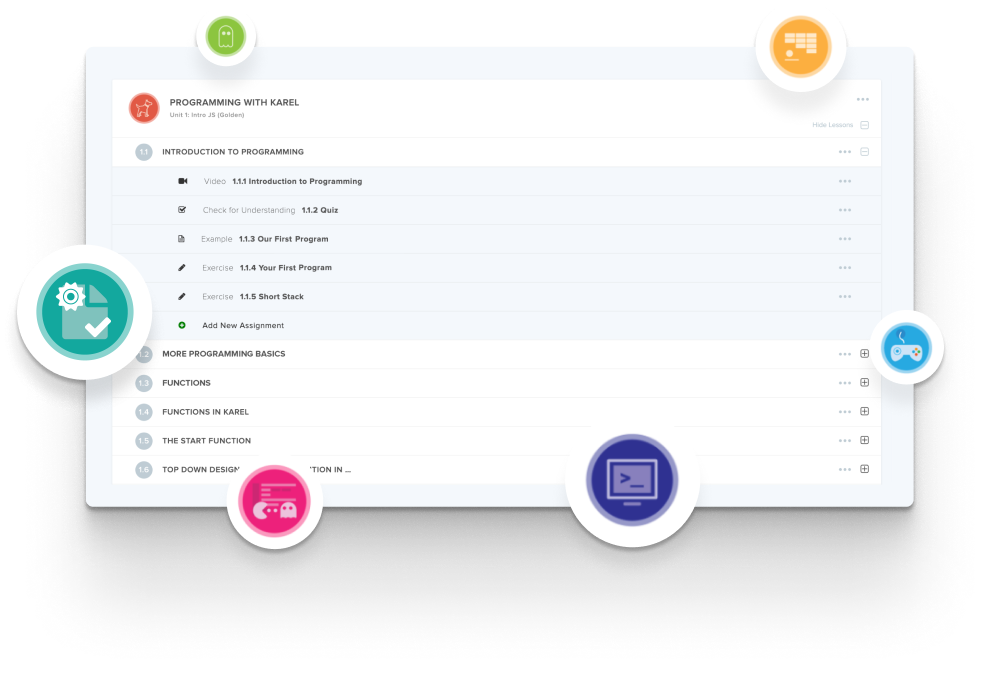
Create and organize Assignments in any CodeHS course that you're teaching. You can even add custom assignments to pre-existing CodeHS courses.
Learn MoreDidn't find what you were looking for? Here are a few links that might be useful to you.
It covers 100% of the Georgia Introduction to Software Technology standards. The CodeHS standards page shows each standard alongside the lesson that covers it, which is what districts usually need for CTAE course documentation.
It is the 9th grade course in three Georgia CTAE pathways: Computer Science, Web Development, and Programming. All three start here.
JavaScript. Students start with Karel, a simplified four-command version of JavaScript, then move into JavaScript basics, graphics and control structures.
Digital citizenship and cyber hygiene, computing basics, operating systems and software, programming with Karel and JavaScript, control structures, HTML and CSS web design, web development, computer science careers, and an IT professional project. It ends with a final exam.
About 160 contact hours, built to run across a full school year.
The two courses carry the same description but teach different things. Software Technology is roughly half programming: Karel, JavaScript, control structures, HTML and CSS. Hardware Technology has no programming units at all and is operating systems, internal components, networking, IT support and digital forensics. Pick Software Technology if you want students writing code.
Georgia Computer Science Principles is the 10th grade course in all three of the same CTAE pathways. In the Web Development pathway, Georgia Web Development follows in 11th grade.