





Georgia Web Development
- Level High School
- Contact Hours 145
- Timeframe Year
This course is intended to teach students the fundamentals of web development in a project-based learning environment. Students are taught the basic elements of web development, such as web hosting, creating HTML/CSS files, and incorporating Javascript into HTML files.
To view the entire syllabus, click here or click to explore the full course.
MODULES - 11
Students learn about the language behind all websites: HTML. Students learn about several different HTML tags as well as the basic structure of a web page. Students use HTML to develop several of their own creative web pages.
Students learn the language CSS and use it to style their web pages. Students learn about the benefits of styling with CSS and will use CSS to create several styled web pages of their own.
This module dives deeper into different things we can do with HTML and CSS. Students practice advanced topics in HTML and CSS, including visibility, image filtering, interaction, and animation, to develop more advanced websites.
Students build their own websites about themselves. This site will be accessible on their own custom domain and will be continually improved by the student as they continue on in the course. It will serve as a running portfolio of each creative project they create in the course.
Students learn about the script tag, and how it can be used to write JavaScript code in their HTML files. Students will also be introduced to useful JavaScript methods that can be used to alter the state of the CSS and HTML of a webpage, as well as how the Document Object Model supports the ability to make such changes.
Students are introduced to jQuery, a JavaScript library that makes webpage interaction easier. Students will learn the basic syntax of jQuery, how to incorporate it in their webpages, and useful methods that help animate and change the responsiveness of their websites.
Students create a single page, interactive resume. Students are expected to add several animations using jQuery to prove their ability to modify HTML and CSS. This unit also examines web design theories that can help students improve the aesthetics of their resumes, and to evaluate the quality of a website based on its layout.
Students explore the role that data plays in creating websites. Students will learn about the various ways that data is taken from webpages, as well as ways to secure themselves from unwanted data collection. Students also learn how to incorporate data collection into their own websites, and collect simple information from users.
Students explore how to store web files, secure a domain name, and maintain a website. The majority of the lessons will be explanatory - students will not be expected to host and maintain a webpage off CodeHS, but will be given the tools needed to do so if they desire.
Students are tasked with creating a website of their own choosing. The website will have to follow specific criteria - certain number of pages, responsiveness, and use of APIs. Students go through a feedback process, and learn about making their websites more accessible to a wide array of users.
Students take some time to explore and discover different computer science careers and professional student organizations. They will also examine inclusive coding and how to avoid bias in computer programming.
Explore programs that your students will build throughout this course!
Here are a few examples of teacher resources and materials to use in the Georgia Web Development course
The CodeHS Web Design Level 1 Certification offers high school students the opportunity to validate their mastery of Web Design, giving them a competitive advantage when entering college or the workforce.
Learn More| Standards Framework | Alignment |
|---|---|
| Georgia Web Development | 100% View |
| Certiport IT Specialist HTML and CSS | 88% View |
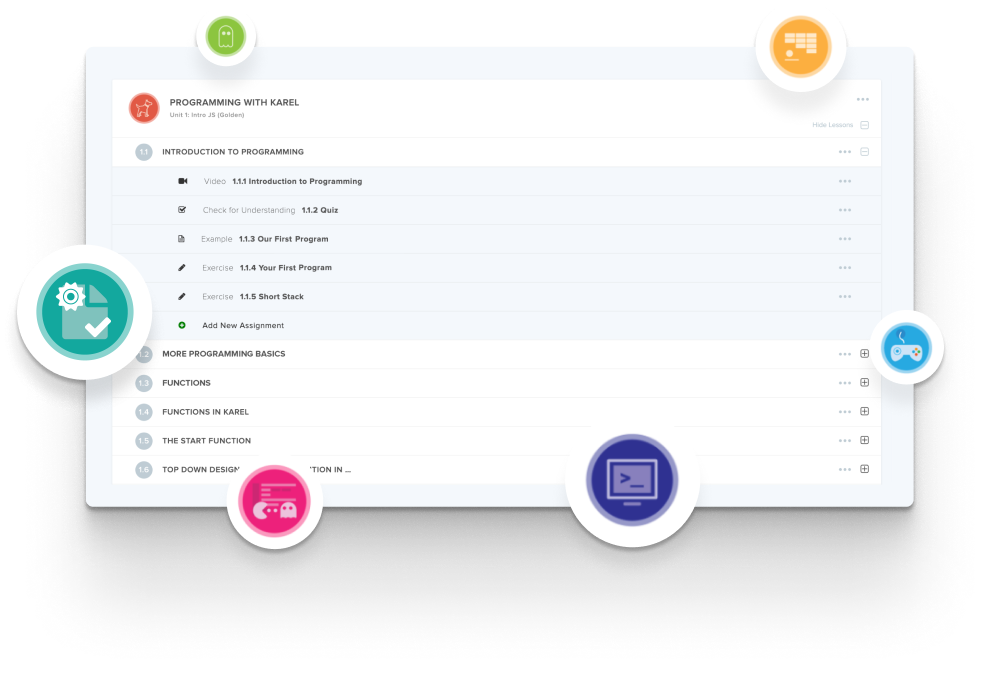
Create and organize Assignments in any CodeHS course that you're teaching. You can even add custom assignments to pre-existing CodeHS courses.
Learn MoreDidn't find what you were looking for? Here are a few links that might be useful to you.
It covers 100% of the Georgia Web Development standards.
It includes two certification practice modules, Web Development Level 1 and Web Design Level 1, and covers 88% of the Certiport IT Specialist HTML and CSS objectives.
HTML, CSS and JavaScript. Students structure pages in HTML, style them in CSS, then add behaviour with JavaScript and JavaScript libraries.
The course is project-based. Students create their own homepage, build an interactive resume, and iterate on their web development work, alongside units on storing and collecting data and on how to build and maintain a website.
It is the 11th grade course in the Georgia CTAE Web Development pathway. CodeHS also lists it under the Georgia state pathway for grades 11 and 12.
About 145 contact hours, built to run across a full school year.
Same content and same 145 hours. This is the Georgia-aligned version: it covers 100% of the Georgia Web Development standards, where the general CodeHS Web Development course covers 76% of them. Use this one if you are reporting against Georgia CTAE.
In the Georgia CTAE Web Development pathway, students take Georgia Introduction to Software Technology in 9th grade and Georgia Computer Science Principles in 10th before reaching this course in 11th.