Introduction to Computer Science in JavaScript (Bulldog)
- Level High School
- Contact Hours 175
- Timeframe Year
This is the honors version of the CodeHS Introduction to Computer Science course in JavaScript. This is geared for advanced high school students as a first programming course. The data structures modules are included in the main course.
To view the entire syllabus, click here or click to explore the full course.
MODULES - 18
Students learn the basics of programming by giving Karel the Dog commands in a grid world.
Students apply all the foundational concepts from Intro to Karel to solve new challenges.
Students learn the basics of JavaScript including variables, user input, mathematics, and functions.
Students learn how to add graphics objects and position them on the canvas.
Students apply what they have learned about graphics and basic JavaScript to complete a set of challenges.
Students learn how to use control structures such as if/else statements and loops to make advanced programs in JavaScript.
Students apply the foundational concepts from the Control Structures module to solve new challenges.
Students learn to write reusable code with functions, parameters, and return values, and explore the impact of variable scopes.
Students use what they have learned in the Functions module to solve new challenges.
Students learn how to make objects move around the screen and let users interact using the mouse!
Students apply all the foundational concepts from the Animations module to solve new challenges.
Students learn how to make their own Breakout game from scratch using JavaScript.
Students learn about arrays, how to iterate through them, and how to take advantage of their default methods.
Students learn about objects, how to create object properties and methods, iterate through them, and build constructors.
Students create their own game of Tic-Tac-Toe by applying what they have learned about data structures.
Students demonstrate their programming prowess as they develop the classic Helicopter game one step at a time.
Students apply the skills they've learned throughout the course to create an original program!
This course ends with a 25 question multiple choice exam.
Explore programs that your students will build throughout this course!
Here are a few examples of teacher resources and materials to use in the Introduction to Computer Science in JavaScript (Bulldog) course
Dive into the basics of programming and learn how to lead a successful introductory computer science class. This course covers everything from learning effective debugging methods to teaching computer science in a blended classroom. Perfect for teachers with limited or no programming experience.
View Units CodeHS PD Options| Standards Framework | Alignment |
|---|---|
| Colorado Coding I | 50% View |
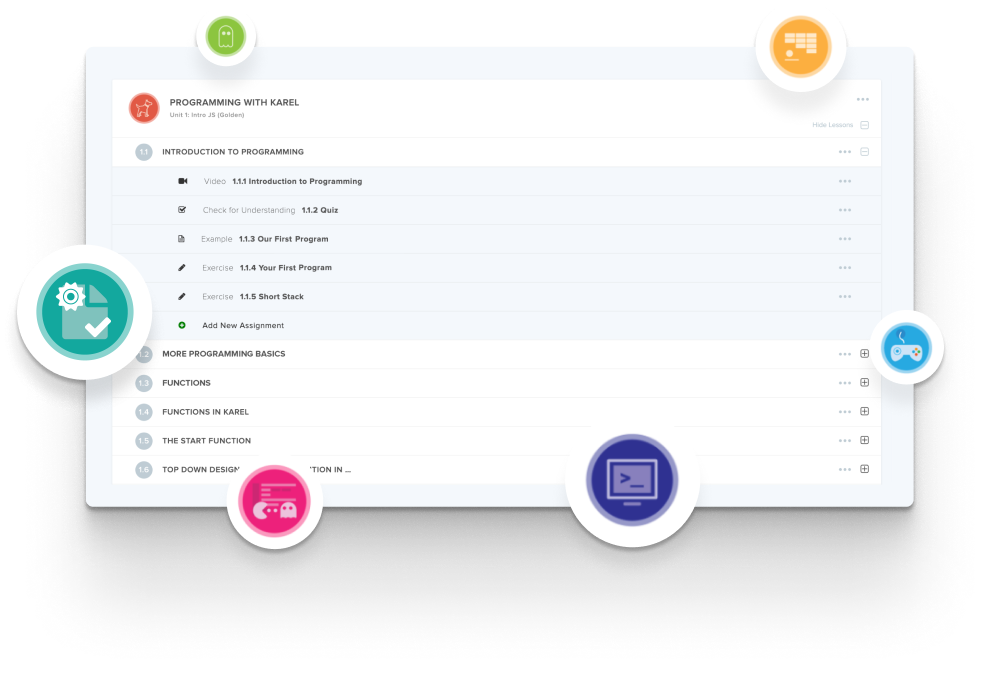
Create and organize Assignments in any CodeHS course that you're teaching. You can even add custom assignments to pre-existing CodeHS courses.
Learn MoreDidn't find what you were looking for? Here are a few links that might be useful to you.
You also might like
Year-long, regular level JavaScript course (does not include data structures)
Year-long, honors level JavaScript course that includes data structures and game projects
Length and depth. At 175 contact hours it is the longest of the JavaScript intro courses, suited for advanced high school students taking their first programming course. The material is the same introduction to computer science content as our Corgi flavor, with the addition of two data structures modules -- Arrays and Objects.
Yes. It is a first programming course, aimed at advanced students rather than experienced ones. No prior coding is assumed.
JavaScript throughout.
Yes. Teaching Intro Computer Science in JavaScript is attached as its professional development course, and the same PD covers all versions.
Introduction to Computer Science in JavaScript (Collie) is the same core course compressed into 75 hours for a single semester (removing all animation and data structure content).
About 175 contact hours, built to run across a full school year. Actual time will vary depending on class schedule and student abilities/experience.
Yes. This course includes two data structures modules -- one focusing on arrays and the other on objects.