


Introduction to Python Programming
- Level High School
- Contact Hours 120
- Timeframe Year
Introduction to Python Programming introduces students to the fundamentals of computer programming, with an emphasis on helping students develop logical thinking and problem-solving skills. Students begin by learning to design, code, and test their programs while applying mathematical concepts. Students then move to more advanced programming concepts and learn to create more powerful programs using functions, strings, data structures, and file i/o operations.
To view the entire syllabus, click here or click to explore the full course.
MODULES - 16
Students gain an understanding of what the course is about and reflect on what they hope to learn.
Students learn the basics of programming by giving Karel the Dog commands in a grid world.
Students learn the basics of programming by writing programs that interact with users through the keyboard.
Students write a program that allows users to create their own Mad Lib stories using variables and user input.
Students teach their programs to make decisions based on the information it receives.
Students write a program that quizzes users on a series of multiple-choice questions and checks their answers.
Students learn how to write more efficient code by using loops as shortcuts.
Students write a program to provide feedback on whether the entered password is correct or incorrect.
Students learn how their programs can be decomposed into smaller pieces that work together to solve a problem.
Students learn more sophisticated strategies for manipulating text in their programs.
Students program a classic two-player game played with a 6 sided die.
Students learn how tuples and lists are formed and the various methods that can alter them.
Students learn to build more complex programs that make use of grids and dictionaries.
Students write a program for a word guessing game.
Students learn to read, write, and process information from text files.
Students learn the key roles and responsibilities of members of a software development team.
Explore programs that your students will build throughout this course!
Here are a few examples of teacher resources and materials to use in the Introduction to Python Programming course
| Standards Framework | Alignment |
|---|---|
| PCEP-30-02 Exam | 100% View |
| Certiport IT Specialist Python | 100% View |
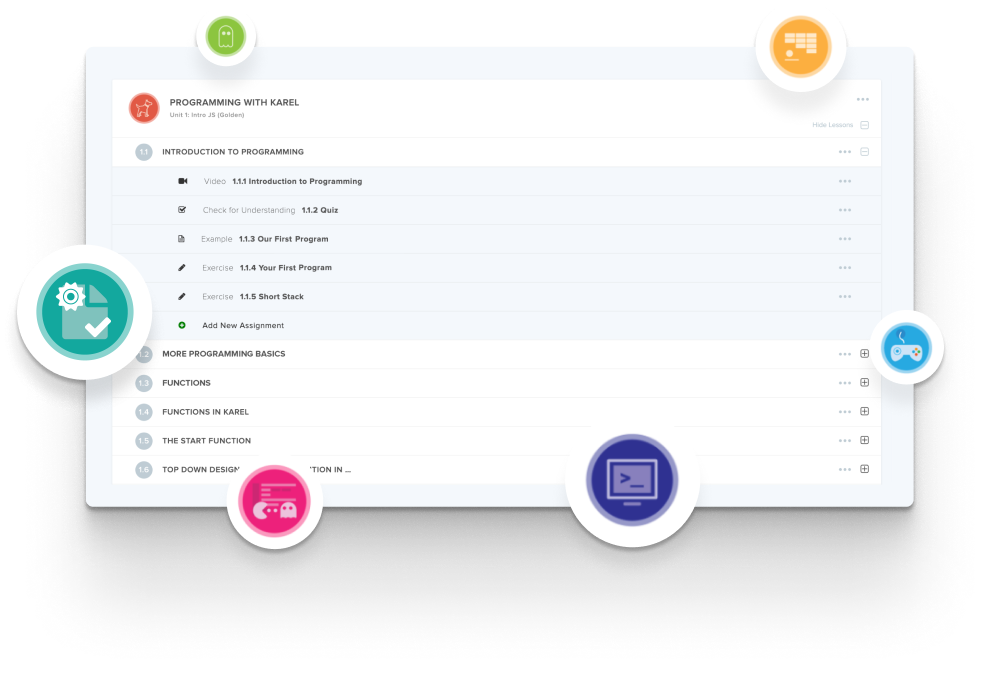
Create and organize Assignments in any CodeHS course that you're teaching. You can even add custom assignments to pre-existing CodeHS courses.
Learn MoreDidn't find what you were looking for? Here are a few links that might be useful to you.
You also might like
Which python course should I use? Click here
Yes. CodeHS designed Introduction to Python Programming as a first computer science course, and it starts from zero with no prior coding experience needed. Students begin with visual Karel the Dog puzzles to build programming logic like loops and conditions, then move into writing real Python. It's a strong fit for high school students taking their first CS class.
No. Introduction to Python Programming assumes no prior coding experience. It opens with Karel the Dog, a visual grid world where students practice sequencing, loops, and conditions before writing Python syntax. Basic math is plenty: the CodeHS course reinforces mathematical concepts as students code rather than requiring advanced math, so true beginners can start with confidence.
Students build a series of interactive Python programs in Introduction to Python Programming, including a Mad Libs story generator, a multiple-choice Quiz Game, a Password Authenticator, the two-player dice game Pig, and a Guess the Word game. Along the way they work with functions, strings, lists, dictionaries, and reading and writing files.
Python is a great first language because its clean, readable syntax lets beginners focus on problem-solving instead of fussing with punctuation. Introduction to Python Programming teaches Python, one of the most widely used languages in data science, artificial intelligence, and web development, so the foundational skills students build carry directly into later CodeHS courses, college classes, and real jobs.
Both are beginner CodeHS courses that start with Karel the Dog and cover the same core programming concepts, so the main difference is the language. Introduction to Python Programming teaches Python, favored in data science and AI, while Introduction to Computer Science in JavaScript teaches JavaScript, the language behind interactive web pages. Choose the one that matches your program's pathway.
Introduction to Python Programming is a full-year course of about 120 contact hours, and it runs entirely in a web browser with nothing to install, so it works on Chromebooks and any school computer. Schools that prefer semester scheduling can teach it as two 60-hour halves, Introduction to Python Programming 1 and Introduction to Python Programming 2.
Yes. Introduction to Python Programming prepares students for the CodeHS Python Level 1 Certification and is also aligned to the PCEP (Certified Entry-Level Python Programmer) exam and the Certiport IT Specialist Python certification. The course includes dedicated certification practice modules to help students build toward these entry-level Python credentials, though earning any certification still depends on the exam itself.
After Introduction to Python Programming, CodeHS recommends AP Computer Science Principles in Python to pursue college credit, or Data Science with Python to apply coding to real datasets. Both lead toward Applications of AI and Machine Learning. The course anchors the CodeHS Python and Artificial Intelligence pathways for high school.