





Nebraska Introduction to Computer Science and Technology
- Level Middle School, High School
- Contact Hours 80
- Timeframe Semester
This introductory course develops students’ abilities to analyze, evaluate, and reflect upon technologies such as computer hardware, computer software, networking, and security. Students will learn the fundamentals of programming, build computational thinking skills, and reflect on the impact of computing on society.
To view the entire syllabus, click here or click to explore the full course.
MODULES - 6
Students learn about cybersecurity essentials, recent cybersecurity threats, and different careers in the field. Students also look at the potential effects of our digital footprints, how to protect information from online risks, and the implications of cyberbullying.
Students dive into the history of cryptography systems, the motivation behind using encryption systems, and basic cryptography systems. Additionally, students explore topics on how to use cryptography, cryptology, and cryptanalysis.
Students compare and contrast common operating systems (Windows, Linux, OS) and explain the importance of application security. Students investigate security options and implement user accounts to enforce authentication and authorization. Students also demonstrate how to work with basic and advanced command prompts.
Students explore the structure and design of the internet and networks, and how this design affects the reliability of network communication, the security of data, and personal privacy. Students learn how the Internet connects computers all over the world by using networking protocols.
Students learn about the physical elements of computers and networking, such as motherboards, RAM, routers, and the use of port numbers, ethernet, and wireless devices.
Students learn Python commands, functions, and control structures by drawing shapes on their screen and solving puzzles with Turtle Graphics.
Explore programs that your students will build throughout this course!
Here are a few examples of teacher resources and materials to use in the Nebraska Introduction to Computer Science and Technology course
| Standards Framework | Alignment |
|---|---|
| Nebraska Computer Science and Technology | 100% View |
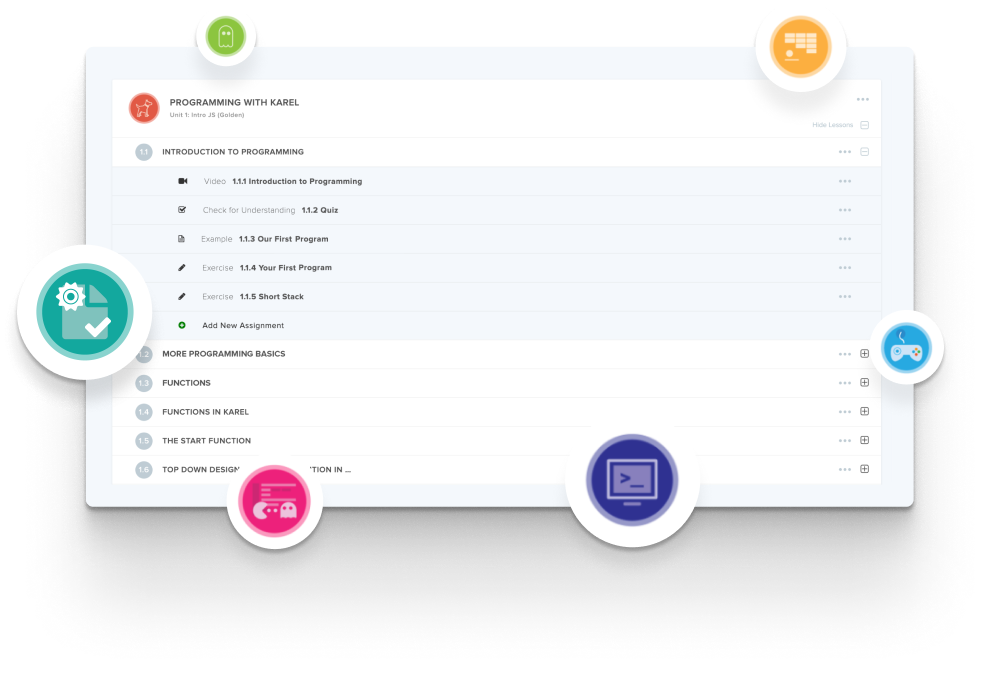
Create and organize Assignments in any CodeHS course that you're teaching. You can even add custom assignments to pre-existing CodeHS courses.
Learn MoreDidn't find what you were looking for? Here are a few links that might be useful to you.
You also might like
1 Year High School course
It covers 100% of the Nebraska Computer Science and Technology standards. The CodeHS standards page lists each standard next to the lesson that covers it.
Three. There are separate units for Turtle Graphics, JavaScript, and Python, so students see more than one language rather than going deep in one.
Analysing and evaluating computer hardware, software, networking and security; the fundamentals of programming; computational thinking; and the impact of computing on society. Units run through cybersecurity, cryptography, system administration, IT concepts, IT infrastructure and data security.
CodeHS places it at 9th grade in the Nebraska High School Computer Science pathway.
All three cover 100% of the same Nebraska framework, so pick by timetable and by how soon you want students coding. This is the standard semester version. The one-year version is 125 hours and adds an escape-room project and a troubleshooting project. The Coding First version is 65 hours and moves the programming units to the front of the course.